📖 Course Overview
Written for the people who own the paperwork when an inspector, a customer auditor, or an incident investigator walks in — and who know that "we did the training" means nothing if you can't prove it.
- ›Primary: Maintenance Managers & Supervisors, Plant Managers, Safety/EHS
Managers, Operations Managers, Reliability Engineers.
- ›Also valuable for: HR & Training Coordinators, Technical Trainers, Compliance
Professionals, and industrial business owners. It applies across general manufacturing, warehousing and logistics, utilities and municipal services, construction, and any OSHA-covered employer with real maintenance and safety-training obligations. Primary focus: internal employee training and documentation. Contractor and temporary-worker documentation is covered as a limited advanced subsection (Module 9), not the core of the course.
Most training citations do not happen because the training was skipped. They happen because the employer could not produce a complete record proving it occurred, who attended, what was covered, and that the worker understood it. Documentation failures are more common than training failures. The same records that satisfy a regulator are the records that make your plant run — so we build the system for operations first, and let the compliance evidence fall out as a by-product. > Course philosophy — "Operations First, Compliance Second." Safety > documentation and machine reliability are one discipline. Clean, versioned, > retrievable records make work faster, troubleshooting methodical, and handoffs > cleaner. Compliance is an outcome; operational excellence is the objective.
By the end of this course you will be able to:
- 1Explain why documentation — not just training delivery — drives OSHA
citations and operational risk.
- 1Identify the training and documentation obligations that apply across OSHA
standards using OSHA Publication 2254.
- 1Develop a compliant training record that proves competency, not just
attendance.
- 1Design an inspection-ready documentation system, physical and digital, with
standardized forms and defined workflows.
- 1Apply the EPA QA/G-6 structure to write SOPs that train, guide, and prove.
- 2Analyze how SOPs, training, inspections, and corrective actions link into one
reinforcing loop.
- 1Evaluate retention and retrieval requirements and build a schedule that keeps
records both compliant and findable.
- 1Demonstrate digital document control — version control, e-sign-offs, audit
trails, QR access — integrated across HR, LMS, CMMS, and document management.
- 1Develop a training matrix and governance model that keeps requirements
current, including for contractors.
- 1Evaluate program health with five KPIs and use them to drive continuous
improvement and operational memory.
- ›Basic knowledge of OSHA's role and enforcement.
- ›Familiarity with common safety programs (HazCom, LOTO, confined space, etc.).
- ›Basic understanding of maintenance/operations workflows (work orders, inspections,
PMs).
— Module 1 — Why Documentation Matters for OSHA and Operations
Before we build anything, internalize one idea: in the eyes of a regulator, undocumented work did not happen. This module makes the operational and compliance case for treating documentation as a first-class system and frames everything that follows.
- ›Explain the three jobs every safety record performs.
- ›Identify how documentation failures — not absent training — become citations.
- ›Evaluate a record using retrievability as the real test of its worth.
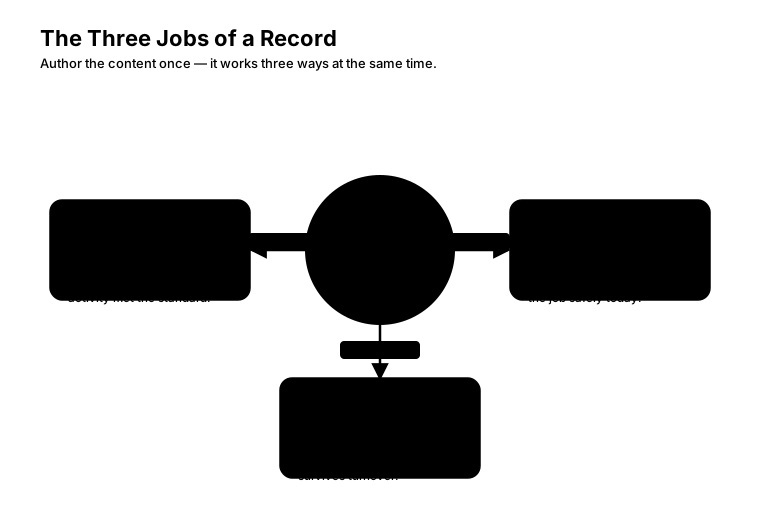
The three jobs your documentation does. Every safety and maintenance record serves three functions at once, and a good system serves all three:
- 1Compliance evidence — proof to OSHA, a customer auditor, or an insurer that a
required activity occurred and met the standard.
- 1Operational instruction — the SOP, permit, or checklist that tells a worker
how to do the job safely and correctly today.
- 1Operational memory — the durable record of how the plant works, so knowledge
survives turnover, shift changes, and retirements. Systems built only for #1 become "audit theater": binders nobody uses. Systems built for #2 and #3 tend to satisfy #1 automatically, because the evidence is generated by the work itself.
How documentation failures become citations. OSHA's General Duty Clause and dozens of standards carry documentation obligations. When an inspector cannot be shown a complete, contemporaneous record, the finding is usually the same whether the training happened or not: the employer has not demonstrated compliance. Best practices
- ›Treat "can we retrieve the proof in under 10 minutes?" as the real test, not "does
a record exist somewhere."
- ›Design records to be generated by doing the work (a signed permit, a completed
checklist), not as separate paperwork afterward.
- ›Give every program a defined home for its records and a named owner.
Common mistakes
- ›Assuming delivered training equals defensible training.
- ›Storing knowledge in people instead of documents.
- ›Records that live only in one supervisor's desk, inbox, or laptop.
Ray, a night-shift maintenance supervisor, inherits a stamping-press line after the day-shift lead retires. The retiree always blocked the ram before a die change because of a stored-energy hazard in the counterbalance — but that step lived only in his head. Two months later a millwright, working from tribal knowledge, is nearly struck during a die change. Ray pulls the "training record" and finds a five-year-old sign-in sheet and no SOP. His decision: rather than write a warning, he opens a corrective action, authors a machine-specific SOP with an explicit ram-blocking step, and re-trains the crew with a documented competency check. The near-miss becomes the moment the knowledge finally entered the system — where the next supervisor will inherit it as a record, not a rumor.
The same failure mode recurs across equipment: gravity backfeed on inclined conveyors, stored pneumatic/hydraulic pressure in pumps and compressors, and rotational inertia in mixers and agitators. In each case the hazard is well understood by veterans and invisible in the records — until an incident or an audit exposes the gap. The pattern is consistent: strong informal practice, weak documentation.
The recording and reporting duties under 29 CFR 1904 (the OSHA 300 log, 300A summary, 301 incident report) add a standing documentation obligation on top of every program-specific record. Educational reference only — always confirm current requirements against the standard that applies to your operation.
Operational memory is the whole game. IronDox captures the steps, hazards, checks, and records of a job in one reusable structure — so the same content that trains a new hire, guides the task, and proves compliance is authored once and stays linked. When knowledge lives in the system instead of a retiree's head, onboarding and shift handoffs stop being acts of faith and become repeatable operations.
- ›Undocumented work is, for compliance purposes, work that didn't happen.
- ›Records serve compliance, operation, and memory — build for all three.
- ›Citations frequently stem from missing or unretrievable records, not absent training.
- ›The real test of a record is fast retrieval, not mere existence.
— Module 2 — Training & Documentation Requirements Across OSHA Standards
There is no single OSHA rule that says "here is everything you must document." Obligations are scattered across dozens of standards — which is exactly why safety managers lose track. This module gives you a repeatable method to build a master list of what your facility must document.
- ›Identify the standards that impose training and documentation duties on your
operation.
- ›Apply OSHA Publication 2254 as an index to build a master requirements list.
- ›Analyze program-specific requirements for frequency, content, and retention.
The fragmented-requirements problem. Training and documentation duties appear throughout 29 CFR 1910 and beyond. OSHA Publication 2254, "Training Requirements in OSHA Standards," compiles these obligations and describes baseline documentation expectations: the identity of the trainee, the date, and the means used to verify understanding. Use it as your index, then confirm each requirement against the specific standard. A representative map of program-specific requirements. Treat retention notes as starting points and verify against the current standard and your state plan.
| Standard | Program | Documentation / training touchpoint |
|---|---|---|
| 29 CFR 1910.147 | Lockout/Tagout | Energy-control procedures; training of authorized, affected, and other employees; annual periodic inspection of each procedure, documented. |
| 29 CFR 1910.1200 | Hazard Communication | Written HazCom program; SDS library; training on hazards and labeling. |
| 29 CFR 1910.120 | HAZWOPER | Certification of training completion incl. trainee name, date, and subject matter. |
| 29 CFR 1910.1030 | Bloodborne Pathogens | Training records retained 3 years, incl. dates, content summary, trainer qualifications, attendee identities. |
| 29 CFR 1910.119 | Process Safety Management | Documentation that each employee operating a process is trained; identifies employee, date, verification method. |
| 29 CFR 1910.134 | Respiratory Protection | Fit-test and training records kept for the duration of active respirator use; PLHCP medical evaluations fall under 1910.1020 (employment + 30 yrs). |
| 29 CFR 1910.178 | Powered Industrial Trucks | Documented training + performance evaluation; operator evaluation at least every 3 years. |
| 29 CFR 1904 | Injury & Illness Recordkeeping | OSHA 300 log, 300A summary, 301 incident report. |
> 📥 Downloadable Resource (placeholder — file to be produced): OSHA > Documentation Master Checklist — every record type mapped to its standard, > frequency, and retention. Best practices
- 1Start from OSHA Publication 2254 to enumerate applicable standards.
- 2Record required elements, frequency, and retention per program in one master
register.
- 1Re-run the exercise whenever you add equipment, a process, or a chemical.
Common mistakes
- ›Documenting the "famous" programs (LOTO, HazCom) and missing quieter ones
(bloodborne pathogens for first-aid responders, hearing conservation).
- ›Assuming one retention period fits all records.
The master-list exercise is exactly what a Documentation System Audit Generator accelerates: feed it your programs and current records, and it returns a gap analysis — which standards apply, which required elements are missing, and where retention is undefined — so a fragmented landscape becomes one reviewed checklist you can act on.
Dana, an EHS manager at a mid-size plant, is asked by a new customer for proof of the site's training program. She builds a master list from Publication 2254 and discovers a quiet gap: the volunteer first-aid team handles blood-cleanup but has no bloodborne pathogens (1910.1030) training records. Her decision: rather than paper over it before the customer visit, she schedules the training, documents it with the required 3-year-retention fields, and adds bloodborne pathogens as a standing column in the training matrix so it can never fall off the radar again. The customer audit passes — and, more importantly, the responders are actually protected.
A plant runs HazCom, LOTO, forklifts, confined space, respiratory protection, and hot work — six programs, each with its own training frequency, record content, and retention expectation. No one manages that reliably from memory; the facilities that stay inspection-ready keep a single living register mapping asset → program → required record.
- ›No universal rule exists; obligations are distributed across many standards.
- ›Publication 2254 is your index; the specific standard is your authority.
- ›Build a master register of elements, frequency, and retention — and refresh it when
the operation changes.
— Module 3 — Core Elements of a Compliant Training Record
Auditors grade completeness, not effort. This module defines the fields every training record should carry and — critically — how to document competency rather than mere attendance.
- ›Identify the elements that make a training record compliant.
- ›Develop a record that ties training to a specific standard.
- ›Demonstrate at least three acceptable methods of documenting competency.
The required elements. Across standards, compliant records converge on a common set:
| Field | Why it matters |
|---|---|
| Employee name and identifier | Ties the record to a specific person. |
| Job title and department | Establishes role relevance and scope. |
| Training date and duration | Proves when and how much. |
| Topics covered + OSHA standard reference | Links training to the obligation it satisfies. |
| Trainer name and qualifications | Establishes instructor competence. |
| Delivery method (classroom / online / OJT) | Describes how training occurred. |
| Proof of comprehension | Test score, demonstration, or certification. |
| Employee acknowledgment (signature) | Confirms participation. |
| Retention period / review status | Governs how long to keep the record. |
Attendance is not competency. A sign-in sheet proves presence, not understanding. Document competency with at least one of:
- ›Written test — score stored with the record.
- ›Practical demonstration — a checklist of observed behaviors, signed by the
evaluator (the model behind forklift performance evaluations under 1910.178).
- ›On-the-job observation and sign-off — for skills that must be shown, not
described. > 📥 Downloadable Resource (placeholder — file to be produced): Training Record > Template · Competency Assessment form. Best practices
- ›Standardize one training-record form so every trainer captures the same fields.
- ›Always record the standard reference — it converts a generic record into
program-specific evidence.
- ›Capture comprehension at the event, while the trainer and evaluator are present.
Common mistakes
- ›Relying solely on sign-in sheets.
- ›Omitting trainer qualifications, duration, or the standard reference.
- ›Inconsistent formats across supervisors, making records hard to audit.
A configurable training-record form with required fields enforced — plus a Training Record Generator that turns event details (standard, topics, attendees, trainer, duration, assessment) into a complete, standardized record — removes the single most common citation driver: the incomplete record. Enforce the fields once, and every trainer produces audit-grade output.
Luis, a training coordinator, is asked during an incident investigation for the LOTO training record of an injured authorized employee. What he finds is a sign-in sheet: names and a date, nothing else. His decision: he doesn't backfill the record from memory (which would be indefensible). Instead he documents the gap honestly, then rebuilds the program's records going forward — every LOTO session now captures the standard reference, topics, a written test score, and an observed lockout demonstration signed by the evaluator. The investigation still stings, but the next audit finds bulletproof records.
A weak LOTO record lists only names and a date. A strong one reads: "29 CFR 1910.147; topics — energy types, isolation, verification of zero energy, group lockout; delivery — classroom + hands-on on Press #4; assessment — written test (score) + observed lockout demonstration; trainer — [name, qualifications]." Same training event; only the second record survives scrutiny.
- ›Compliant records share a common element set; missing fields create exposure.
- ›Always tie the record to the specific standard.
- ›Document comprehension (test, demonstration, or observed sign-off), not just
attendance.
— Module 4 — Designing a Safety Documentation System (Binder + Digital)
Individual records are only as good as the system that holds them. This module covers the architecture of an inspection-ready system — what it contains, how it's organized, and the workflows that keep it fed.
- ›Identify the components of an inspection-ready documentation system.
- ›Design standardized forms and a defined records workflow.
- ›Apply a three-axis index (employee, standard, event) for fast retrieval.
What an inspection-ready system contains. Whether physical, digital, or hybrid, a complete system generally holds: OSHA 300/300A/301 forms; written safety policies and programs; hazard assessments and JSAs; training records and matrices; the SDS library; program-specific records (LOTO annual inspections, confined-space permits, fit-test records, forklift certifications, PSM procedures); maintenance and inspection logs; calibration records; and permits and corrective-action records. Standardized forms and defined workflows. Two design decisions separate a sustainable system from an ad-hoc one:
- 1Standardized forms — one approved template per record type, required fields
enforced. This kills the "every supervisor invents their own format" problem.
- 1Defined workflows — every record type has a path: who creates it, who
reviews/approves it, where it's stored, and how it's retrieved.
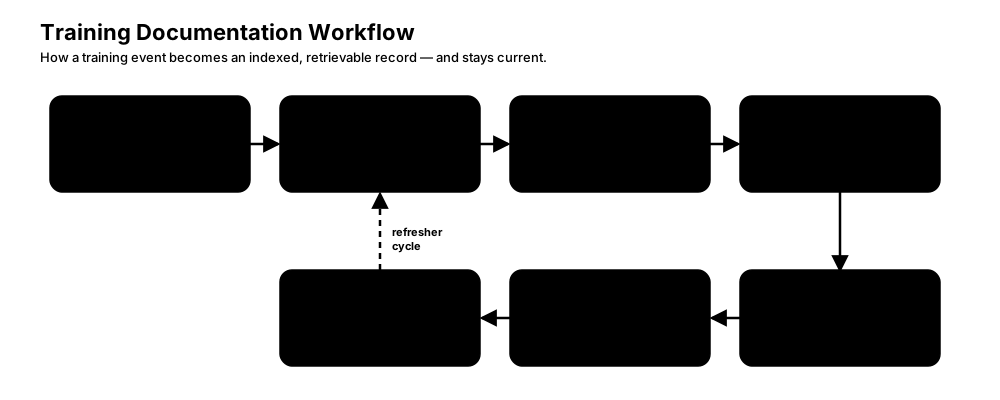
Index every record three ways: by employee, by standard, by event — the exact axes an inspection, investigation, or customer audit queries against. The retrieval clock is real. Under 29 CFR 1904.40, an employer must provide copies of the OSHA 300/300A/301 records to an OSHA investigator within 4 business hours of a request. Design the system so any such record is producible well inside that window — a target of ~15 minutes for any safety record is a reasonable internal standard. A consistent naming convention makes this automatic, e.g. [YYYY-MM-DD]_[Standard-ID]_[Asset-ID]_[Doc-Type]. Note the privacy boundary: keep medical and personal records (respirator medical evaluations, exposure data) under strict role-based access, not in a general safety binder. > 📥 Downloadable Resource (placeholder — file to be produced): Document Control > Log · Documentation System Audit Checklist. Best practices
- ›One template per record type; required fields enforced.
- ›Index by employee, by standard, and by event.
- ›Assign an owner to each record type — ownerless records rot.
Common mistakes
- ›Paper binders and scattered spreadsheets with no version control.
- ›No standard forms; inconsistent, unauditable records.
- ›No defined process for capturing training, inspections, or corrective actions.
The pivotal capability is a documentation module that indexes records by employee, by standard, and by event. Standardized digital forms plus that index turn "audit prep" from a fire drill into a saved filter — the record is produced in the meeting, not hunted for overnight.
Priya, a plant manager, learns a key customer is sending an auditor in ten days. Her records live on a shared drive full of inconsistent Word files named by whoever created them. Her decision: instead of a frantic cleanup, she stands up one indexed library, migrates records tagged by employee, standard, and event, and assigns each record type an owner. Audit prep that used to take three days becomes a filtered query. The auditor asks for "the forklift evaluations for the shipping crew," and Priya produces them in under two minutes — which does more for the customer relationship than any presentation could.
A facility replaces a shared drive of inconsistent files with a single indexed library. During the next unannounced inspection, the compliance officer requests the LOTO annual inspection records for a specific press; the safety lead filters by standard + asset and produces them immediately, and the inspection moves on. The system, not heroics, carried the moment.
- ›An inspection-ready system holds policies, records, permits, SDS, and logs in one
organized place.
- ›Standardized forms plus defined workflows make the system sustainable.
- ›Index by employee, by standard, and by event so retrieval is instant.
— Module 5 — SOP Structure and Documentation Best Practices
The Standard Operating Procedure is the keystone document: it trains, it guides the task, and it becomes audit evidence. This module teaches a proven structure so your procedures serve all three roles.
- ›Apply the EPA QA/G-6 structure to a machine-specific SOP.
- ›Explain why LOTO must isolate the primary energy source, not the control
circuit.
- ›Evaluate whether an SOP matches the work people actually perform.
The EPA QA/G-6 SOP structure. EPA's "Guidance for Preparing Standard Operating Procedures (SOPs)" (EPA QA/G-6) — widely used across regulated industries — lays out a durable skeleton:
| Section | Contents |
|---|---|
| Purpose | Why the procedure exists. |
| Scope | Where/when it applies; boundaries. |
| Responsibilities | Roles that perform, approve, review. |
| Definitions | Terms, acronyms, equipment identifiers. |
| Procedure steps | Numbered, sequential, unambiguous actions. |
| Safety & PPE | Hazards, controls, and required PPE per step. |
| Records & forms | What the procedure generates and where it's filed. |
| References | OEM manuals, standards, related SOPs. |
Isolate the primary energy-isolating device, not the control circuit. A stop button, PLC output, or selector switch is a control device — it can fail or be bypassed. LOTO must act on the primary disconnect or valve that physically breaks the energy path. Techniques such as double block and bleed and physical blocking exist precisely because a single control point cannot be trusted. (Energy comes in several types — electrical, mechanical, hydraulic, pneumatic, thermal, chemical, and gravity/stored — each with its own isolation and dissipation path; see the Regulatory Verification Register, item R2, on avoiding a fixed "count.") Writing steps people actually follow. A procedure that doesn't match reality is worse than none: it fails the worker and destroys credibility in an audit. > 📥 Downloadable Resource (placeholder — file to be produced): SOP Template > (EPA QA/G-6 structure). Best practices
- 1Use short, numbered, one-action steps in the imperative ("Open the main
disconnect").
- 1Put the hazard and its control at the step where it occurs.
- 2Reference OEM procedures and inspection intervals; align the SOP with the
manufacturer's instructions.
- 1Name equipment exactly as it's labeled on the floor (asset IDs, valve tags).
- 2Validate the draft by walking it down with an experienced operator.
Common mistakes
- ›Procedures that describe an idealized process no one follows.
- ›Wall-of-text steps that bury the safety-critical action.
- ›Isolating the control circuit instead of the primary energy source.
- ›No link between the SOP and the records it should generate.
An SOP Structure Generator that drafts to the EPA QA/G-6 skeleton from a process description gives every author the same defensible bones — purpose, scope, responsibilities, numbered steps, per-step PPE, records, references — so the variability that makes SOPs unreliable is engineered out. The author supplies accurate machine detail; the structure is guaranteed.
Sam, a reliability engineer, reviews a LOTO SOP for a hydraulic press and spots a dangerous shortcut: the procedure tells the technician to "press E-stop and place the selector in OFF" — isolating the control circuit, not the main disconnect, and never bleeding the accumulator. His decision: he rewrites the SOP to the QA/G-6 structure with numbered steps that lock the primary disconnect, bleed the hydraulic accumulator, install the safety block against the gravity ram, and verify zero energy before work — then walks it down with the crew before publishing. The rewrite converts a procedure that looked compliant on paper into one that is actually safe on the floor.
For a press with a hydraulic accumulator and a gravity ram, "dissipate stored energy" cannot be prose — it must be numbered actions (bleed the accumulator; install the safety block) each followed by a verification check. Procedures that skip this step are a leading contributor to startup and servicing incidents on stored-energy equipment.
- ›Use the EPA QA/G-6 structure so SOPs train, guide, and prove.
- ›Numbered, one-action steps with per-step hazards and PPE.
- ›LOTO acts on the primary energy-isolating device — never the control circuit.
- ›An SOP that doesn't match real work undermines both safety and audits.
— Module 6 — Linking SOPs, Training, Inspections & Corrective Actions
Isolated documents are fragile. The power of a documentation system comes from the links between records: a procedure trains a worker, an inspection tests the procedure, an incident triggers a correction, and the correction updates the procedure and re-training. This module builds that loop.
- ›Analyze how four record families reinforce each other in one loop.
- ›Develop corrective-action records that link explicitly to retraining and SOP
revisions.
- ›Evaluate when a finding is genuinely closed.
The reinforcing documentation loop. In a mature system, four record families reinforce each other: an SOP trains a worker (training record); an inspection tests the procedure; a finding triggers a corrective action; the corrective action updates the SOP and drives retraining — and the next inspection confirms closure.
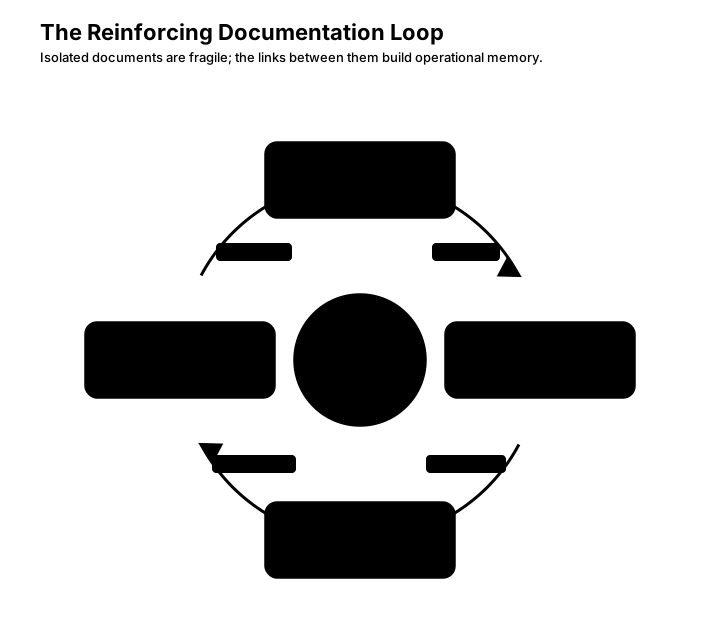
Making the links explicit. Links must be recorded, not implied. A corrective- action record should reference: the triggering incident or inspection, the actions taken, the retraining documentation, and the SOP version updated. > 📥 Downloadable Resource (placeholder — file to be produced): CAPA / Corrective > Action Record · Inspection & Audit Log. Best practices
- ›Give every SOP, record, and finding a stable ID so others can reference it.
- ›On each corrective action, cite the SOP version and the training record it produced.
- ›Close the loop explicitly — a finding isn't done until the verifying record exists.
Common mistakes
- ›Disconnection between documentation and actual practice.
- ›Corrective actions with no link back to retraining or SOP revision.
- ›No documentation of competency verification after a corrective action.
The differentiator most guides miss is integration — showing how SOPs, training records, inspection findings, and corrective actions link so they reinforce each other and build operational memory. An SOP-update workflow tied to incident investigations and audit findings makes the loop automatic: a finding proposes the SOP revision and the retraining, and the links are captured by construction.
Tomás, a maintenance manager, runs the required annual LOTO periodic inspection (1910.147) and observes an authorized employee skip the zero-energy verification step. His decision: he treats it as a system signal, not a personal failing. He opens a corrective action that (1) retrains the employee with a documented competency check, (2) revises the SOP so the verification step is unmissable, and (3) sets a closure criterion — the next inspection must confirm the step is performed. Every arrow in the loop leaves a dated record, so when the customer auditor later asks how findings are handled, Tomás shows the whole chain from observation to closure.
A LOTO periodic inspection finds a skipped verification step. That finding creates a corrective-action record: retrain the employee (new training record), revise the SOP (new version), and confirm closure at the next inspection. Facilities that skip the "confirm closure" step routinely re-discover the same finding a year later — proof the loop was never closed.
- ›Four record families form one reinforcing loop: SOP → training → inspection →
corrective action → back to SOP.
- ›Record the links explicitly with stable IDs and version references.
- ›A finding is closed only when the verifying record exists.
— Module 7 — Record Retention and Accessibility
Keeping records too briefly creates compliance gaps; keeping everything forever with no index creates a haystack. This module covers how long to keep records and how to retrieve them under pressure.
- ›Evaluate the correct retention period for common record types.
- ›Apply a published retention schedule with alerts.
- ›Analyze why retrieval speed is a design requirement, not an afterthought.
Retention rules that actually vary. Retention is program-specific, and the biggest compliance trap is assuming one period covers everything. The single most damaging mistake — the "5-year purge" — is deleting all safety records at five years, which destroys chemical-exposure and medical records that must be kept for the duration of employment plus 30 years under 29 CFR 1910.1020. Treat the table below as the working baseline and confirm against each current standard and any stricter state-plan rule.
| Record class | Example | Minimum retention | Standard |
|---|---|---|---|
| Occupational injury | OSHA 300 / 300A / 301 logs | 5 years after the calendar year covered | 29 CFR 1904.33 |
| Chemical exposure | Air-sampling records, exposure logs | Duration of employment + 30 years | 29 CFR 1910.1020 |
| Medical / surveillance | Respirator medical clearances, audiometric | Duration of employment + 30 years | 29 CFR 1910.1020 |
| Respiratory fit-test / training | QNFT reports, training logs | Duration of active respirator use | 29 CFR 1910.134 |
| Bloodborne pathogens training | Rosters, curriculum, trainer certs | 3 years | 29 CFR 1910.1030 |
| LOTO verifications | Machine-specific annual audits | 1 year minimum (best practice: 5 years — see item S1) | 29 CFR 1910.147(c)(6) |
| Atmospheric permits | Confined-space entry permits | 1 year minimum | 29 CFR 1910.146(e)(6) |
| Operator evaluations | Forklift road-test sheets | 3 years (re-evaluate triennially) | 29 CFR 1910.178(l)(6) |
> Why the 30-year rule matters most. Respiratory, chemical, and medical records > outlive almost everything else in your system because occupational illness can surface > decades after exposure. Segregate these from short-retention records so a routine > cleanup can never reach them. Accessibility is a design requirement. Retention is worthless without retrieval. Records must be producible quickly during inspections, customer audits, and incident investigations — filtered by employee, standard, and event (the three axes from Module 4). > 📥 Downloadable Resource (placeholder — file to be produced): Record Retention > Schedule. Best practices
- 1Publish a retention schedule per record type with the governing source.
- 2Automate retention alerts so nothing is purged early or kept blindly.
- 3Index for retrieval on day one, not at audit time.
- 4Distinguish "archive" (retained but inactive) from "active."
Common mistakes
- ›Purging records before their retention period ends.
- ›Keeping everything with no index — records exist but can't be found.
- ›No documented retention schedule, so decisions are made ad hoc.
Built-in retention rules and alerts — driven by OSHA and company policy — plus archival-status fields solve both failure modes at once: nothing is destroyed early, nothing lingers as clutter, and every record carries its own "keep-until" logic instead of relying on memory.
Grace, a safety manager, inherits a program with a well-meaning habit: an annual "clean the drive" day that deletes anything older than twelve months. After a recordable injury, an investigator asks for the injured worker's LOTO training history — and it's gone. Her decision: she ends the blanket purge immediately, publishes a retention schedule keyed to each standard (5 years for OSHA 300-series, 3 for bloodborne pathogens, and so on), and configures alerts so records are archived, not destroyed, until their period ends. The lesson lands hard, but the program never loses defensible history again.
A plant purges "old" training records at 12 months to save space, then cannot produce an injured worker's LOTO training during an investigation. The cleanup — not the training — created the exposure. Retention discipline is a compliance control in its own right.
- ›Retention is program-specific; publish a schedule and verify against the standard.
- ›OSHA 300-series: 5 years; bloodborne pathogens: 3 years; others vary.
- ›Index for fast retrieval by employee, standard, and event — retention without
retrieval is useless.
— Module 8 — Digital Documentation Systems and Audit Trails
Paper and shared drives can satisfy the letter of the rules but scale poorly and prove little about who did what, when. This module covers digital document control: version control, electronic sign-offs, audit trails, QR-code access — and how these integrate across your HR, LMS, CMMS, and document-management systems.
- ›Demonstrate how version control links a document to the training record.
- ›Explain what an audit trail must capture.
- ›Develop an integrated HR + LMS + CMMS + document-management workflow.
What "digital" adds that paper can't. A well-built digital system contributes four things a binder cannot reliably provide:
- 1Version control — one authoritative current version, full history, and a record
of which version an employee was trained on.
- 1Electronic sign-offs — dated, attributable acknowledgments and approvals.
- 2Audit trails — automatic logging of who created or changed a record, when, and
why.
- 1Instant access — QR codes at the machine link the technician to the current
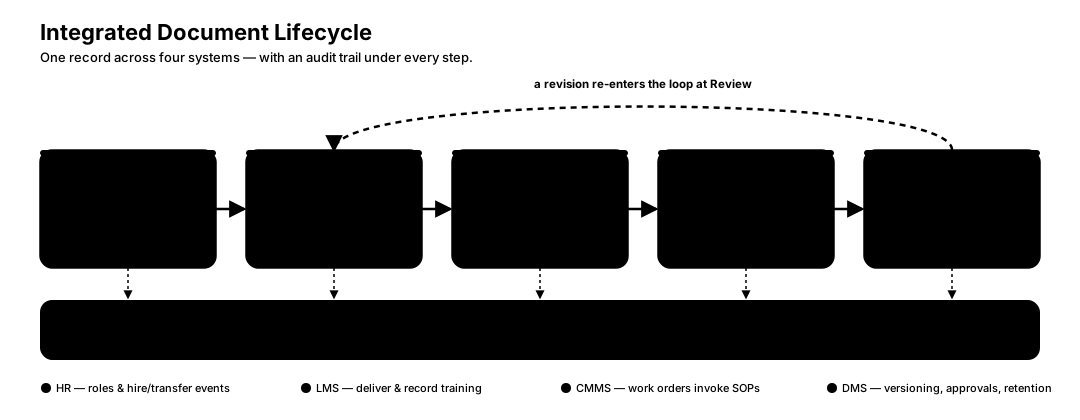
SOP, so the floor and the record are never out of sync. Electronic records and digital signatures can satisfy documentation expectations when they capture the same required elements as paper and preserve integrity and attribution. The technical hallmarks of a defensible system are forced-field validation (a record can't be saved with critical fields blank), an immutable, append-only audit trail (each change generates a hash of user ID, timestamp, and old-vs-new values), role-based access control (RBAC) that restricts deletion to compliance administrators, and NTP-synced clocks so timestamps are trustworthy. > A note on 21 CFR Part 11. The FDA's 21 CFR Part 11 (electronic records and > signatures) is widely used as a benchmark for digital record integrity across > industry. It is an FDA standard, not an OSHA requirement — reference it as a > design target for audit-trail and e-signature integrity, not as a rule OSHA enforces. Integrated systems architecture. Documentation does not live alone. In a mature operation the pieces integrate:
| System | Role in the documentation flow |
|---|---|
| HR system | Source of employees, roles, hire/transfer events → drives who needs what training. |
| LMS | Delivers and records training, assessment scores, and completion → feeds the training record. |
| CMMS | Work orders and PMs invoke the SOP; completion links maintenance history to the procedure. |
| Document management | Version control, approvals, retention, and audit trail for SOPs and records. |
When a new hire is added in HR with a role, the LMS assigns required training, the CMMS exposes the relevant SOPs at the asset, and the document-management layer keeps every version and signature. The result is one operational record instead of four disconnected silos.
> 📥 Downloadable Resource (placeholder — file to be produced): Version Control > Register · Document Control Log. Best practices
- ›Maintain a version-control register (version, effective date, change reason) for
every SOP and training material.
- ›Stamp the SOP version onto each training record it generates.
- ›Require electronic acknowledgment for procedure changes that affect a role.
- ›Keep the audit trail immutable and reviewable.
Common mistakes
- ›Outdated procedures still in circulation with no version marker.
- ›Records that don't show which version an employee was trained on.
- ›Digital systems with no audit trail — you can't prove integrity.
Version control linked to training records (which version an employee was trained on), audit-trail logging of who changed a record and when and why, digital signatures/acknowledgments, and QR-code deployment together form the core of defensible digital document control — and the integration across HR, LMS, and CMMS is what turns compliance evidence into an operating system rather than a filing cabinet.
Ken, an operations manager, gets a call: a technician is about to service a conveyor using a printed SOP from last year — before a pinch-point guard was added and the procedure revised. His decision: rather than rely on catching such moments by luck, Ken rolls out QR codes at each asset that resolve to the current versioned SOP, and configures the system to require electronic re-acknowledgment whenever a procedure affecting a role changes. Now the technician scans the code, sees rev 5, and the version-to-training link has already flagged that he needs the five-minute update before the job. The stale printout problem simply disappears.
A QR code on Press #4 opens the current, version-controlled LOTO SOP, so a superseded revision can't be worked from. When the SOP is revised after an inspection finding, the code resolves to the new version instantly, and the audit trail shows the change author, date, and reason — a complete integrity record with no extra paperwork.
- ›Digital control adds version control, e-sign-offs, audit trails, and instant (QR)
access.
- ›Tie document versions to training records to target re-training precisely.
- ›Integrate HR + LMS + CMMS + document management into one record, not four silos.
- ›Electronic records satisfy expectations when they preserve required elements,
attribution, and integrity.
— Module 9 — Building a Training Matrix & Documentation Governance
The training matrix is the control panel of your program: it ties roles to hazards to required training to documentation. Governance keeps that panel accurate over time. This module builds both — and adds a limited advanced subsection on contractor and temporary-worker documentation.
- ›Develop a training matrix that ties roles, hazards, training, and documentation.
- ›Apply governance — ownership, cadence, and change triggers — to keep it current.
- ›Explain how contractor and temporary-worker documentation differs from internal
employees.
The training matrix. A grid: rows are roles; columns are required training (HazCom, LOTO, confined space, respiratory protection, forklift, etc.), each column carrying its refresh interval and documentation requirement. It answers, at a glance, "who needs what, how often, and what proof."
| Role | HazCom | LOTO (1910.147) | Forklift (1910.178) | Confined space | Respiratory (1910.134) |
|---|---|---|---|---|---|
| Maintenance Tech | ✅ | ✅ authorized + annual periodic insp. | ⬜ if assigned | ✅ if entrant/attendant | ✅ if required + fit test |
| Machine Operator | ✅ | ✅ affected | ⬜ | ⬜ | ⬜ |
| Forklift Driver | ✅ | ✅ affected | ✅ eval ≤ 3 yrs | ⬜ | ⬜ |
| Confined-space Entrant | ✅ | ✅ affected | ⬜ | ✅ + permit | ✅ if atmosphere requires |
Documentation governance. Governance assigns ownership and cadence: a named owner for each program's records; a fixed annual review of programs and the matrix; and change triggers (new equipment, new chemical, incident, or regulatory update) that force a matrix and SOP review. Advanced subsection — contractor & temporary-worker documentation. Internal employees are the core focus of this course, but contractors and temporary workers create distinct documentation needs. Key differences:
- ›Who trains and documents may be split — the staffing agency or contractor may
provide baseline training, while the host employer documents site-specific hazards and verifies competency for host-controlled tasks.
- ›Multi-employer worksites mean records may need to demonstrate coordination
(who covered what) rather than a single training file.
- ›Programs like PSM (1910.119) carry explicit contractor-related obligations;
confirm the specific requirements for your processes.
- ›Best practice: maintain a parallel, clearly labeled contractor training/records
track so host and contractor responsibilities are unambiguous during an audit. > 📥 Downloadable Resource (placeholder — file to be produced): Training Matrix > Template (internal + contractor track) · Competency Assessment. Best practices
- 1Drive assignments from role, not from individual memory.
- 2Review the matrix on a fixed annual cadence and on every change trigger.
- 3Document governance itself (who reviews, when, against what checklist).
Common mistakes
- ›A matrix built once and never maintained.
- ›No owner, so no one notices when a role's requirements drift.
- ›Failing to document retraining after incidents, role changes, or regulatory
updates.
- ›Treating contractors as out of scope for documentation entirely.
A Training Matrix Generator — input roles, hazards, and applicable standards, output a matrix with documentation requirements — turns a static spreadsheet into a living control panel. Paired with a documentation-system audit workflow (scheduled reviews with checklists and corrective actions), the matrix stays current by design rather than by heroics.
Aisha, an HR/training coordinator, onboards a new maintenance technician on a Monday. Her decision: instead of assembling a training plan from memory, she assigns the role in the system, and the matrix immediately generates the required-training list (HazCom, LOTO authorized, confined-space if assigned) and the documentation each event must produce. The same week, a contractor crew arrives for a tank cleaning; Aisha logs them on the clearly labeled contractor track, records the site-specific hazard briefing the host provides, and keeps the agency's baseline certifications on file — so when the auditor asks "how do you handle contractor training?", the answer is a folder, not a shrug.
A new hire is classified as "Maintenance Tech." The matrix instantly produces their required-training list and the documentation each event must generate — no guesswork, no gaps discovered later during an audit. When the role changes, the matrix flags the delta automatically.
- ›The training matrix ties roles → hazards → required training → documentation.
- ›Governance assigns owners, sets an annual review cadence, and defines change
triggers.
- ›Drive assignments from role; maintain the matrix, don't build it once.
- ›Contractors and temp workers need a distinct, clearly labeled documentation track.
— Module 10 — Continuous Improvement & Operational Memory
A documentation system is not a project you finish; it's a program you run. This final module covers the five KPIs that tell you whether your system is healthy, and how documentation becomes durable operational memory.
- ›Evaluate program health using five documentation KPIs.
- ›Apply the reinforcing loop at the program level to drive improvement.
- ›Explain how documentation becomes operational memory that survives turnover.
Five KPIs for a documentation program. These are management metrics, not regulatory requirements. Track them monthly to detect drift before it becomes a citation or an incident.
| # | KPI | What it measures | Target |
|---|---|---|---|
| 1 | Training Record Completeness Rate | % of training records with all required fields present. | → 100% |
| 2 | Documentation Retrieval Time | Median time to produce a requested record. | ↓ minutes |
| 3 | Procedure Currency Rate | % of SOPs within their review interval (not overdue). | → 100% |
| 4 | Competency Verification Rate | % of training events with documented comprehension. | → 100% |
| 5 | Corrective Action Closure Rate | % of findings closed with a verifying record, on time. | → 100% |
Documentation as operational memory. Continuous improvement closes the Module-6 loop at the program level: incident lessons and audit findings feed SOP and training updates, and those updates are captured so the organization learns. Over time the document set becomes the plant's operational memory — the reusable record of steps, hazards, checks, and outcomes that survives turnover and powers onboarding. > 📥 Downloadable Resource (placeholder — file to be produced): Documentation > System Audit Checklist (KPI scorecard). Best practices
- ›Review KPIs monthly; act on trends, not single data points.
- ›Feed every incident and audit finding into an SOP/training update.
- ›Capture "why" alongside "what" so future readers understand the reasoning.
Common mistakes
- ›Measuring nothing, so drift is invisible until an audit or injury exposes it.
- ›Improvements that never make it back into the documents.
- ›Losing the reasoning behind a procedure when the author leaves.
This is IronDox's core thesis: capture and organize operational memory — steps, hazards, checks, and records — in a reusable knowledge architecture that feeds SOP generation and workflow suggestions. A platform that measures its own health (completeness, retrieval time, currency, verification, closure) turns compliance from an annual scramble into a continuously improving operating system.
Marcus, a plant manager, watches one number climb on his monthly scorecard: Documentation Retrieval Time has drifted from 4 minutes to 30 as headcount and record volume grew. His decision: he treats the KPI as an early-warning signal, not a scorecard for blame. Before an inspector ever experiences the slowdown, Marcus commissions an indexing cleanup and adds retrieval-time to the monthly review. Two months later the metric is back under five minutes — and the fix happened on his schedule, not an auditor's.
A plant's Retrieval Time metric climbs as it grows; the rising number surfaces an indexing problem before an inspector experiences it. KPIs like this act as an early-warning system — the value is in catching drift while it's still cheap to fix.
- ›Track five KPIs: completeness, retrieval time, currency, verification, closure.
- ›Feed incidents and findings back into SOPs and training — close the loop.
- ›Well-run documentation becomes operational memory that outlives any individual.
🎓 🎓 Final Knowledge Review
A formative, self-checked review of the whole course — not a scored exam. Work through all 20 questions, then compare your answers against the answer key and explanations that follow. Scored assessment and certificate eligibility are not currently available for this course, so this review produces no pass/fail result; its value is confirming your own understanding across every module.
- 1"Operations First, Compliance Second" means compliance evidence is best produced
as a by-product of real operations. (T/F)
- 1Which regulation establishes the OSHA 300/300A/301 recordkeeping obligation?
- 2The most common root cause of training-related citations is ________.
- 3Which OSHA publication compiles training requirements across standards?
- 4How often must a LOTO energy-control procedure undergo a documented periodic
inspection?
- 1Bloodborne pathogens training records are retained for how long?
- 2Forklift operator performance must be evaluated at least every how many years?
- 3Name three required elements of a compliant training record.
- 4Attendance proves presence; competency requires a test, demonstration, or observed
sign-off. (T/F)
- 1The three indexing axes for a records system are by employee, by ______, and by
______.
- 1Name four sections of the EPA QA/G-6 SOP structure.
- 2Lockout must act on the ________, not the control circuit.
- 3"Double block and bleed" exists because a single control point cannot be trusted.
(T/F)
- 1In the reinforcing loop, an inspection finding should generate a ________.
- 2A corrective action is closed only when ________.
- 3OSHA 300-series records are typically retained for how many years?
- 4The most valuable digital link is between a document's ______ and the training
record.
- 1An audit trail records who changed a record, ______, and ______.
- 2A training matrix ties roles and hazards to required training and ________.
- 3Which KPI best surfaces a growing retrieval/indexing problem?
- 1True — a system built for operations generates compliance evidence by doing the
work (M1).
- 129 CFR 1904 — the standing recordkeeping obligation (M1).
- 2Missing or unretrievable documentation — not absent training (M1).
- 3OSHA Publication 2254 — the index of cross-standard training requirements (M2).
- 4Annually — periodic inspection under 1910.147 (M2/M6).
- 53 years — 1910.1030 (M2/M7).
- 63 years — 1910.178 operator evaluation interval (M2).
- 7Any three: employee name/ID, job title/department, date & duration, topics +
standard reference, trainer name & qualifications, delivery method, proof of comprehension (M3).
- 1True — competency requires evidence of understanding (M3).
- 2Standard, event (M4/M7).
- 3Any four: purpose, scope, responsibilities, definitions, procedure, safety &
PPE, records & forms, references (M5).
- 1Primary energy-isolating device (main disconnect/valve) (M5).
- 2True — redundant isolation because a single control point can fail or be
bypassed (M5).
- 1Corrective action (driving retraining + SOP revision) (M6).
- 2A verifying record confirms the fix (M6).
- 35 years — 1904 (M7).
- 4Version — links a document to which revision an employee trained on (M8).
- 5When, why (M8).
- 6Documentation (M9).
- 7Documentation Retrieval Time (M10).
| Q | Module | Course objective assessed |
|---|---|---|
| 1, 4? | M1 | Obj. 1 — explain why documentation drives citations/risk |
| 2, 3 | M1 | Obj. 1 |
| 4, 5, 6, 7 | M2 | Obj. 2 — identify obligations across standards |
| 8, 9 | M3 | Obj. 3 — develop a competency-proving record |
| 10 | M4 | Obj. 4 — design an inspection-ready system |
| 11, 12, 13 | M5 | Obj. 5 — apply the EPA QA/G-6 structure |
| 14, 15 | M6 | Obj. 6 — analyze the reinforcing loop |
| 16 | M7 | Obj. 7 — evaluate retention & retrieval |
| 17, 18 | M8 | Obj. 8 — demonstrate digital document control |
| 19 | M9 | Obj. 9 — develop a matrix & governance |
| 20 | M10 | Obj. 10 — evaluate program health with KPIs |
🧰 🧰 Practical Exercise — Build a Program-Specific Documentation Package
Objective: produce a complete, inspection-ready documentation package for one program (recommended: Lockout/Tagout on a single machine), demonstrating every skill in the course. Choose one machine with at least two energy sources (e.g., a hydraulic press, a mixer, or an inclined conveyor), then produce:
- 1Master-list entry — applicable standard(s), required elements, training
frequency, retention (M2).
- 1SOP — machine-specific energy-control SOP in EPA QA/G-6 structure, with numbered
steps, per-step hazards/PPE, an explicit dissipate-stored-energy step, and a verify zero energy step (M5).
- 1Training record — for one authorized employee, all required fields + a
documented competency method (M3), stamped with the SOP version (M8).
- 1Annual periodic inspection form — the 1910.147 record; simulate one finding
(M6).
- 1Corrective action record — link the finding to retraining and an SOP revision,
with closure criteria (M6).
- 1Retention & index entry — retention per record type + the three retrieval tags
(employee / standard / event) (M4, M7).
- 1Version-control register line — SOP version, effective date, change reason (M8).
Success criteria: a reviewer given only your package can (a) train a new authorized employee, (b) locate any record in under 5 minutes, and (c) trace the finding → retraining → SOP revision loop end-to-end.
📥 📥 Downloadable Resources
> All resources are labeled placeholders; actual files are produced in a later design > phase. Each is generic, industrial-ready, and aligned to the regulations and best > practices in this course.
| Resource | Purpose / key fields |
|---|---|
| OSHA Documentation Master Checklist | OSHA 300/300A/301, policies, hazard assessments, training records, SDS, maintenance logs, permits. |
| Training Record Template | Name/ID, title, department, topic, standard reference, date, duration, trainer & qualifications, delivery method, assessment & score, acknowledgment. |
| Training Matrix Template | Roles × required training with refresh intervals and documentation requirements (internal + contractor track). |
| SOP Template (EPA QA/G-6) | Purpose, scope, responsibilities, definitions, steps, safety & PPE, records & forms, references. |
| Inspection & Audit Log | Date, inspector, area, findings, corrective actions, follow-up, references. |
| CAPA / Corrective Action Record | Links incident/inspection → actions → retraining → SOP update → closure. |
| Documentation System Audit Checklist | Completeness, retention, accessibility, consistency, KPI scorecard. |
| Version Control Register | SOP/training-material versions with effective dates and change reasons. |
| Record Retention Schedule | Retention period + governing source per record type. |
| Document Control Log | Create/approve/publish/retire history with owners. |
| Competency Assessment | Written-test and observed-demonstration templates. |
⚠ ⚠️ Regulatory Verification Register
> Per Publication Standard Article II, the following items are carried from the > approved sources without alteration and are flagged for subject-matter/legal > verification before Release. Do not "correct," tighten, or invent around them.
| # | Item | Status |
|---|---|---|
| R1 | Respiratory protection record retention. Resolved by the authoritative technical draft (`02-technical-draft.md`): fit-test/training records kept for the duration of active respirator use; PLHCP medical/exposure records under 1910.1020 (employment + 30 yrs). | Resolved — sourced |
| R2 | Number of "forms" of hazardous energy — course refers to energy types without asserting a fixed count. | Resolved by wording |
| R3 | General training-record retention now stated with sourced periods (1904.33; 1910.1020; etc.) rather than a vague "+ several years." | Resolved — sourced |
| R4 | Established retention/interval figures (1904.33: 5 yr; 1910.1030: 3 yr; 1910.178(l)(6): 3 yr; 1910.146(e)(6): 1 yr) retained with a standing "verify against current standard / stricter state plan" disclaimer. | Low risk — disclaimer applied |
| S1 | LOTO periodic-inspection certification retention stated as "1 year minimum, best practice 5 years" (from the technical draft). 1910.147 does not prescribe an explicit retention period; the 5-year figure is best practice, not a rule. | Open — verify wording |
| S2 | FDA 21 CFR Part 11 (Module 8) is an FDA electronic-records benchmark, not an OSHA mandate. Course frames it explicitly as a benchmark used in non-FDA industries. Confirm framing is retained through QA. | Low risk — framing note |
| S3 | "4 business hours" to produce OSHA 300-series records to an investigator (29 CFR 1904.40, Module 4). Established; confirm against current text. | Low risk — cited |
✅ ✅ Certificate & Scored Assessment
Scored assessment and certificate eligibility are not currently available for this course. The Final Knowledge Review above is a formative self-assessment — it is not scored, produces no pass/fail result, and does not issue a credential. Working through all 10 modules, the Knowledge Checks, the Final Knowledge Review, and the Practical Exercise builds and demonstrates your understanding, but no certificate is granted at this time. > For reference — what an IronDox Academy Certificate of Completion is, and is not. > An IronDox Academy Certificate of Completion certifies completion of an IronDox course > and demonstrated understanding of its material. It is not a government > certification, an > OSHA-approved or OSHA-accredited credential, a CEU award, or a substitute for the > hands-on, employer-provided, standard-specific training and competency evaluation > that OSHA standards require (for example, machine-specific LOTO authorization or a > forklift operator evaluation). Employers remain responsible for site- and > equipment-specific training and documentation.
➡ ➡️ Next Recommended Courses
- 1Lockout/Tagout (LOTO): Creating OSHA-Compliant Energy Isolation Procedures.
- 2**Industrial Energy Control Systems: Engineering, Compliance & Operational
Excellence** (flagship advanced).
- 1HazCom & SDS Documentation: Building a Chemical Safety Program.
- 2Confined Space Entry: Permits, Training, and Documentation Systems.
- 3Respiratory Protection: Fit-Testing, Training, and Recordkeeping.
- 4Building an Integrated Safety and Maintenance Documentation System.
❓ ❓ Frequently Asked Questions
What training records does OSHA actually require me to keep? There is no single list — requirements are distributed across standards. Use OSHA Publication 2254 to enumerate applicable standards, then capture each standard's required elements: trainee identity, date, topics, the standard reference, trainer qualifications, delivery method, and proof of comprehension. How long must I keep training records and incident reports? It varies by program: OSHA 300/300A/301 records are typically kept 5 years (1904); bloodborne pathogens training records 3 years (1910.1030); respiratory-protection records are tied to continued use and medical-record rules (verify — see R1). Many general training records are kept for the duration of employment plus several years as best practice. Verify against the standard that applies to you. What makes a training record "compliant" versus just an attendance sheet? Completeness and proof of comprehension: a compliant record ties a named employee to a specific standard, date, duration, topics, qualified trainer, delivery method, and documented competency — not just a signature confirming presence. Do digital signatures and electronic records satisfy OSHA? They can, when they capture the same required elements as paper and preserve attribution and integrity (a reviewable audit trail of who changed what, when, and why). Confirm the specifics for your program and jurisdiction. How do I document competency, not just attendance? A written test with a stored score, a practical demonstration scored against an observed-behaviors checklist, or an on-the-job observation with an evaluator sign-off — the same model as a forklift performance evaluation. How do I keep the system inspection-ready all year? Standardize forms, index records by employee/standard/event, publish a retention schedule with alerts, run the reinforcing loop (SOP → training → inspection → corrective action), govern with a maintained training matrix and scheduled reviews, and watch the five KPIs monthly.
Part of the IronDox Academy Compliance & Operational Documentation track, conforming to IronDox Academy Publication Standard v1.1. IronDox is an AI-powered industrial documentation platform for SOP generation, compliance intelligence, and CMMS-integrated operational memory. This course is educational and does not constitute legal advice; verify all regulatory requirements against the current standards and your applicable OSHA jurisdiction.
🚀 Build This in IronDox
You now have the framework. The last step is turning it into controlled, audit-ready procedures — without the manual drag that keeps most SOP programs stuck in draft form.
Here is how the exact methodology from this guide maps to IronDox:
- 1Scan — Capture equipment reality at the source. Photograph the nameplate, the control panel, the isolation points. IronDox reads model numbers, voltages, and pressures directly from the image so the procedure is built around the asset in front of you — not a generic template.
- 2Speak — Walk the job out loud the way your retiring expert would. IronDox structures spoken field knowledge into sequenced steps, so tribal knowledge becomes a controlled document before it walks out the door.
- 3Generate — Produce a complete first draft in minutes: purpose, scope, roles, PPE, tools, prerequisites, step-level hazard warnings, verification checks, and a revision block — formatted to a consistent standard.
- 4Review — Route the draft to a qualified reviewer and approver. Nothing reaches the floor without sign-off, and every change is captured in the revision history.
- 5Publish — Release to a searchable, point-of-use library with version control. Technicians always see the current revision; obsolete copies are retired automatically.
This is the same Capture → Structure → Safety → Review → Deploy → Improve lifecycle you just learned — operationalized.